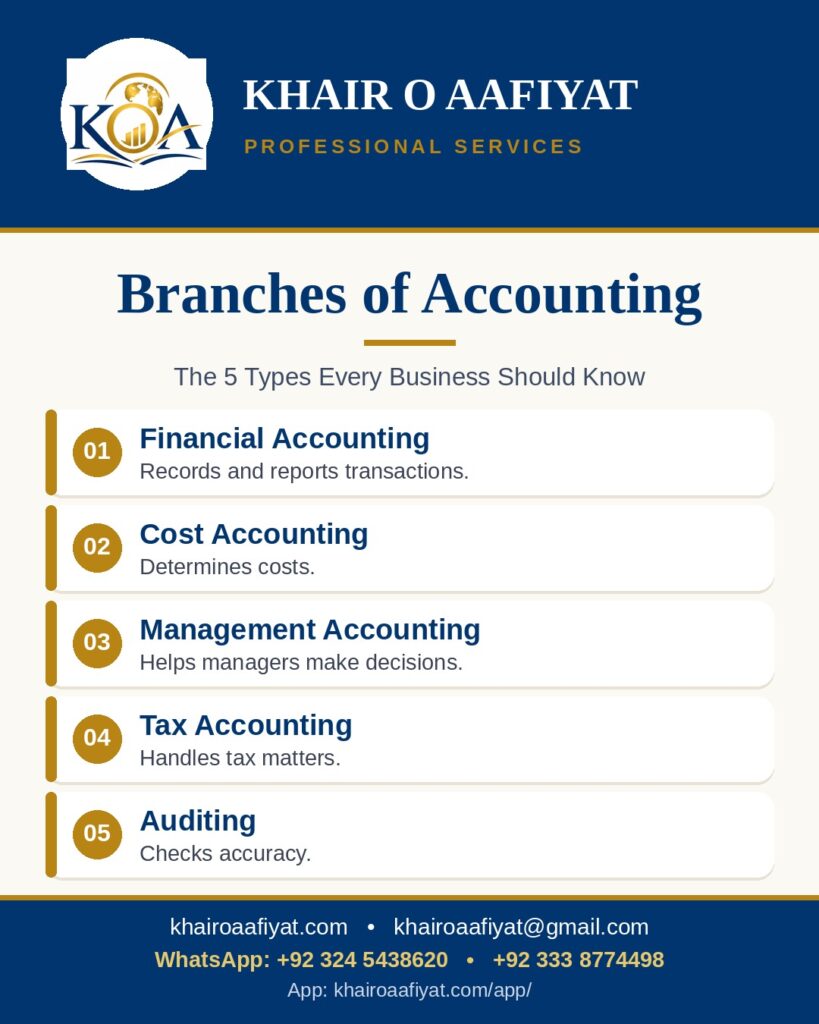
Accounting is often spoken of as if it were one job. It is not. Accounting has five main branches, and each one answers a different question about a business. One records what happened. One works out what things cost. One helps managers decide what to do next. One handles tax. And one checks that the numbers are right.
If you are learning accounting, starting a business, or trying to understand your own accounts, knowing these five branches makes everything else easier. This guide explains each one in plain words, with a small example.
1. Financial Accounting — Records and reports transactions
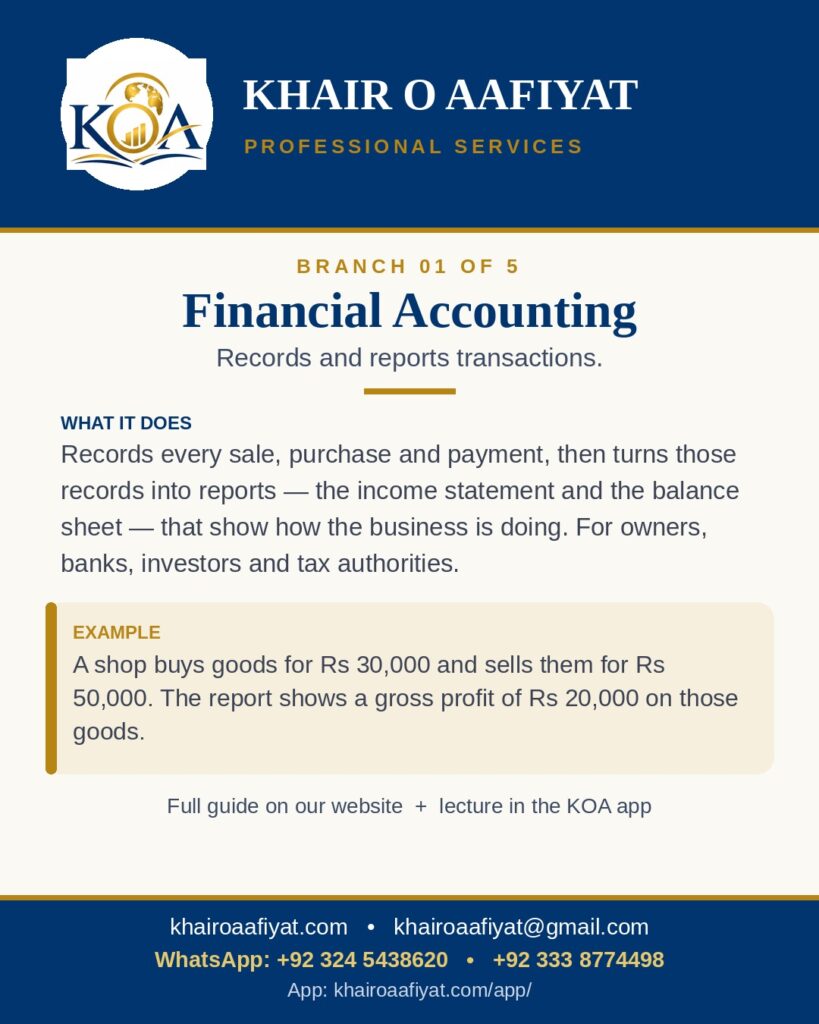
Financial accounting records every transaction a business makes — every sale, purchase and payment — and turns those records into reports that show how the business is doing. The main reports are the income statement, which shows what the business earned and spent, and the balance sheet, which shows what it owns and owes. These reports are for owners, banks, investors and tax authorities.
Example: A small shop buys goods for Rs 30,000 and sells them for Rs 50,000. Financial accounting records both amounts, and the report shows a gross profit of Rs 20,000 on those goods.
2. Cost Accounting — Determines costs
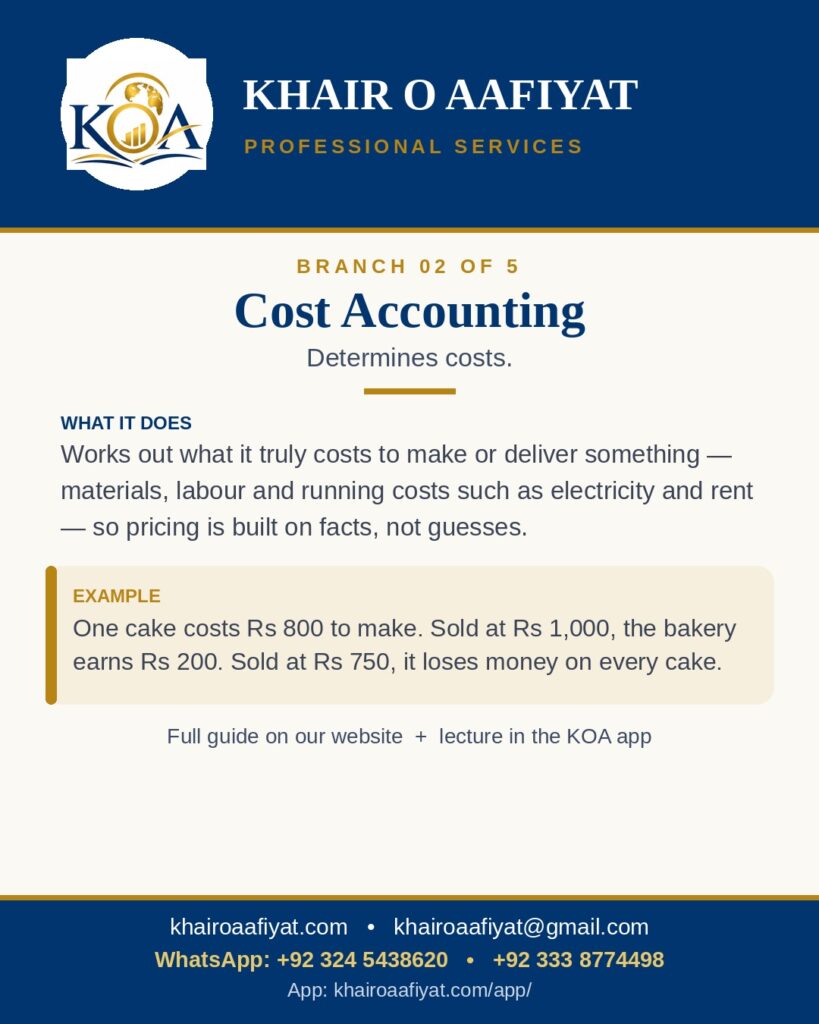
Cost accounting works out what it actually costs to make or deliver something. It adds up materials, labour, and running costs such as electricity and rent, so the business knows the true cost of each product or service. That number is what fair pricing is built on.
Example: A bakery works out that one cake costs Rs 800 to make — flour, sugar, eggs, gas and the baker’s time. Sold at Rs 1,000, the bakery earns Rs 200 on each cake. Sold at Rs 750, it loses money on every cake, however busy the shop looks.
3. Management Accounting — Helps managers make decisions
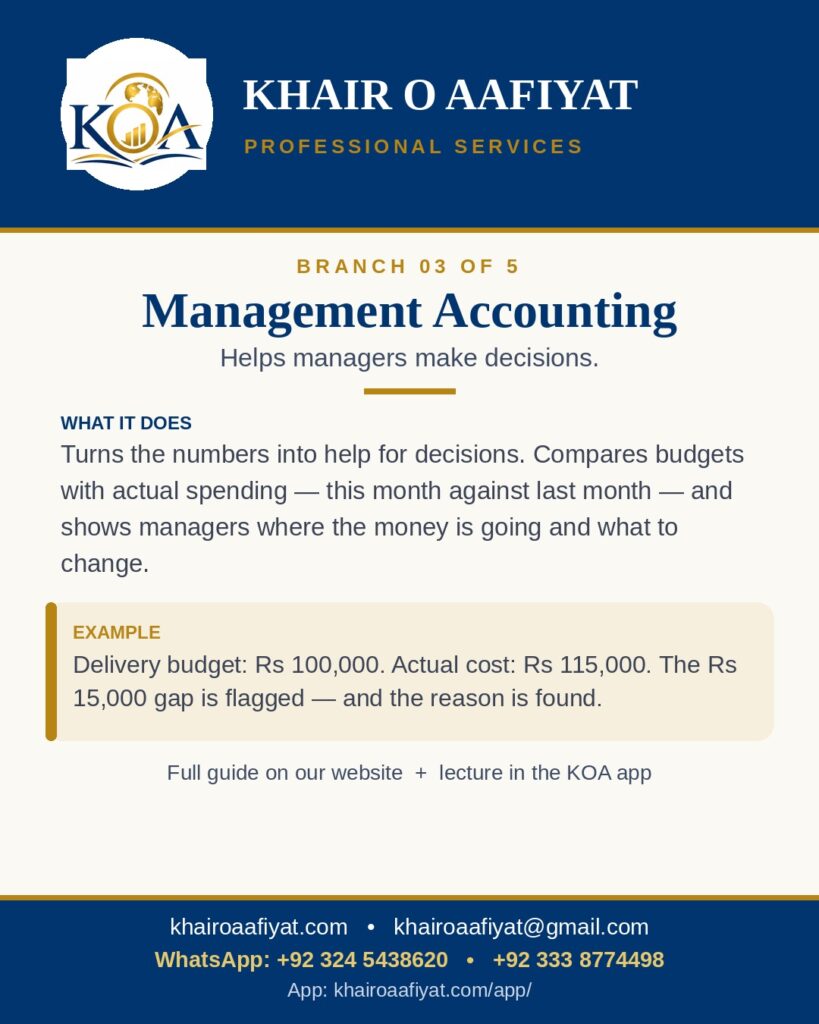
Management accounting takes the numbers and turns them into help for decisions. It compares plans with reality — budgets against actual spending, this month against last month — and shows managers where the money is going and what to change. Its reports are for the people running the business, not for outsiders.
Example: A manager budgets Rs 100,000 for delivery in a month, but the actual cost is Rs 115,000. Management accounting flags the Rs 15,000 gap and helps the manager find the reason — more orders, a longer route, or a price rise — and decide what to change next month.
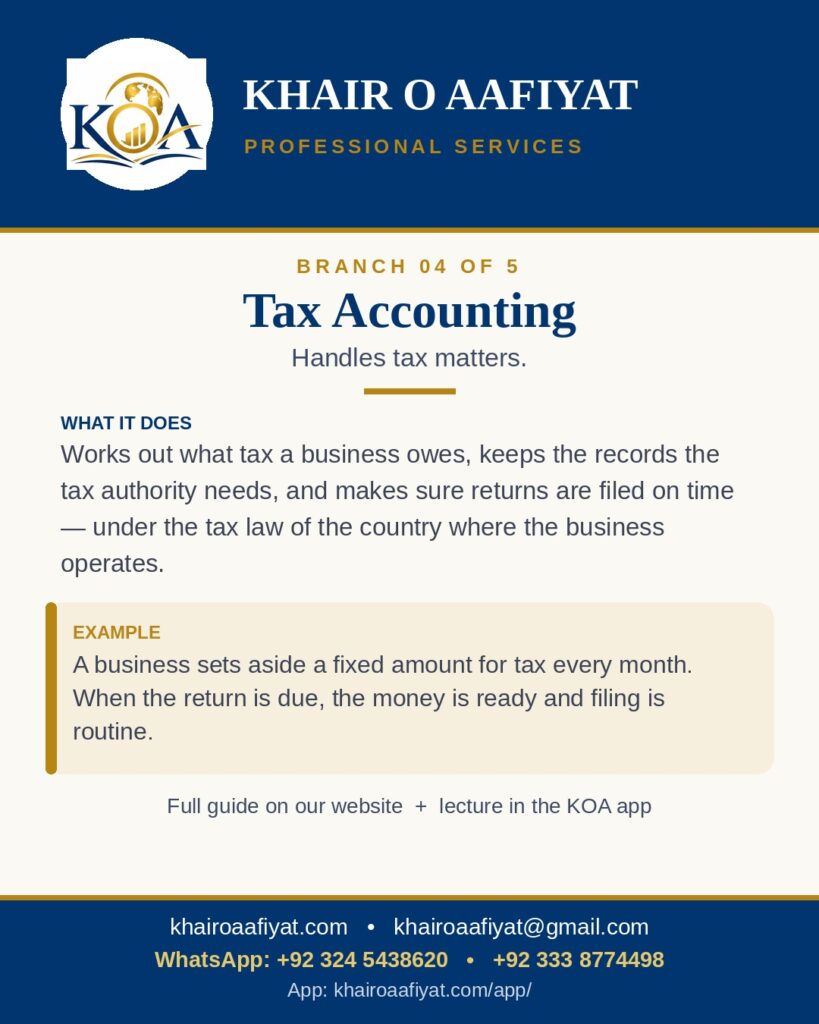
4. Tax Accounting — Handles tax matters
Tax accounting works out what tax a business owes, keeps the records the tax authority needs, and makes sure returns are filed on time. It follows the tax law of the country where the business operates, and keeps the business on the right side of deadlines and rules.
Example: A small business puts aside a fixed amount from its income every month for tax, instead of waiting for the tax bill to arrive. When the return is due, the money is already there, the records are ready, and filing is a routine job instead of a scramble.
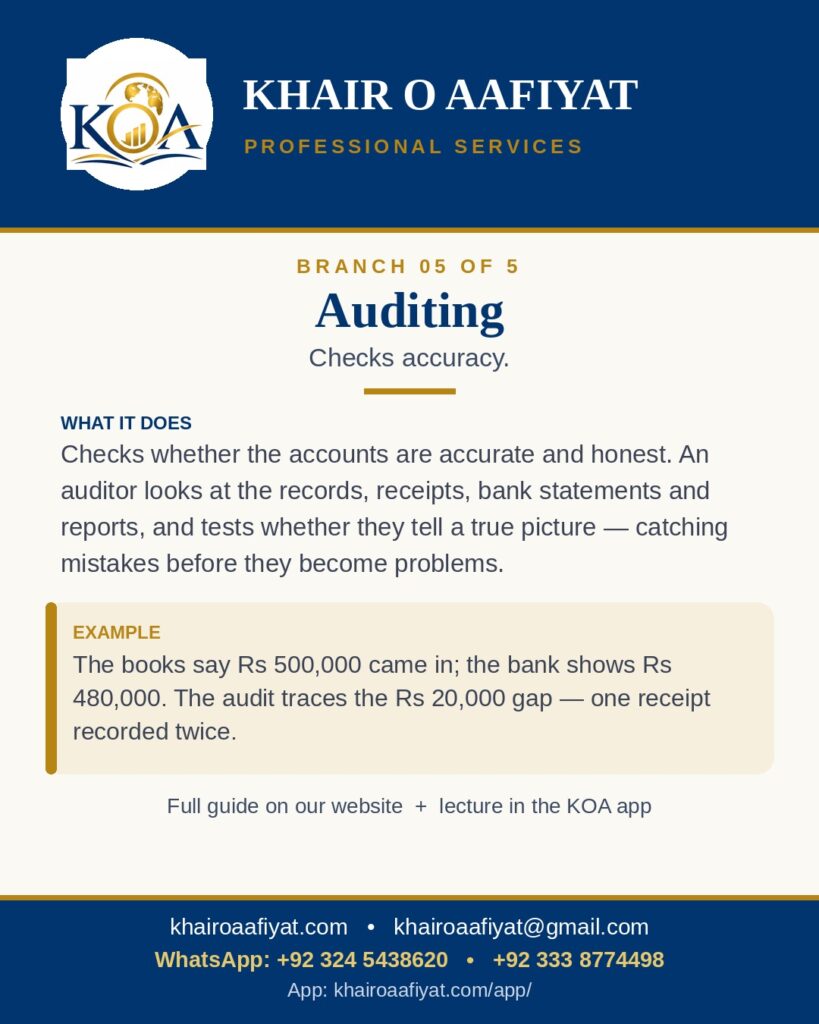
5. Auditing — Checks accuracy
Auditing checks whether the accounts are accurate and honest. An auditor looks at the records, the receipts, the bank statements and the reports, and tests whether they tell a true picture. Auditing does not prepare the accounts — it checks them, and catches mistakes before they become serious problems.
Example: A business’s books say it received Rs 500,000 from customers in a month, but the bank statement shows Rs 480,000. An audit traces the Rs 20,000 gap and finds one receipt recorded twice. One check, one small correction — and the accounts are right again.
Which branch does your business need?
Every business needs financial accounting first — without records, nothing else works. Tax accounting comes with it, because every business must meet its tax duties. As the business grows, cost accounting helps with pricing and management accounting helps with decisions. Auditing is the check that keeps the rest honest — small businesses can do simple internal checks themselves, and larger businesses bring in an independent auditor.
The five branches are not rivals. They are five parts of one system: record it, cost it, use it to decide, pay the tax on it, and check it.
This is general information only, not individual tax or accounting advice. For your own case, get proper guidance.
Author: Dr. Muhammad Asif, CEO, Khair O Aafiyat
Email: khairoaafiyat@gmail.com · Website: https://khairoaafiyat.com/ · App: https://khairoaafiyat.com/app/ · YouTube: https://www.youtube.com/@AllInOneHubGlobal10 · WhatsApp (text only): +92 324 5438620 · +92 333 8774498 · +971 50 135 9046